The cool part: Snowflake is turning meaning and AI behavior into governed platform objects.
Semantic Views, Horizon Context, Cortex AI Functions, AI Function Studio, Snowflake Intelligence/Cortex Agents, CoWork, Snowflake Postgres/SPCS, DCM/Dynamic Tables, Interactive Tables, AtScale XMLA, and pg_lake all point at the same shift: Snowflake is trying to govern not just data, but the context and functions that let AI do work.
The highest-leverage threads are the architecture pattern, implications for agentic data products, Horizon Context/Semantic Views, Cortex AI Functions, AI Function Studio, and CoWork/Cortex Agents.
The announcements make more sense as one operating model: governed data becomes governed work when semantics, freshness, AI functions, agents, and approvals are connected.
Operational / source dataPostgres, apps, documents, lake files
Business meaningSemantic Views, ontology metadata, Horizon Context
→
Low-latency servingInteractive Tables / Warehouses where query shapes are hot
→
Evaluated AI toolsCortex AI Functions, Function Studio, Analyst, Search, graph analytics
→
Work surfacesCoWork, Cortex Agents, MCP actions, Power BI, Excel, Sigma
The defensible enterprise claim: AI becomes useful when data freshness, business meaning, access control, semantic consistency, function quality, cost controls, approvals, and action surfaces are all governed through lifecycle controls.
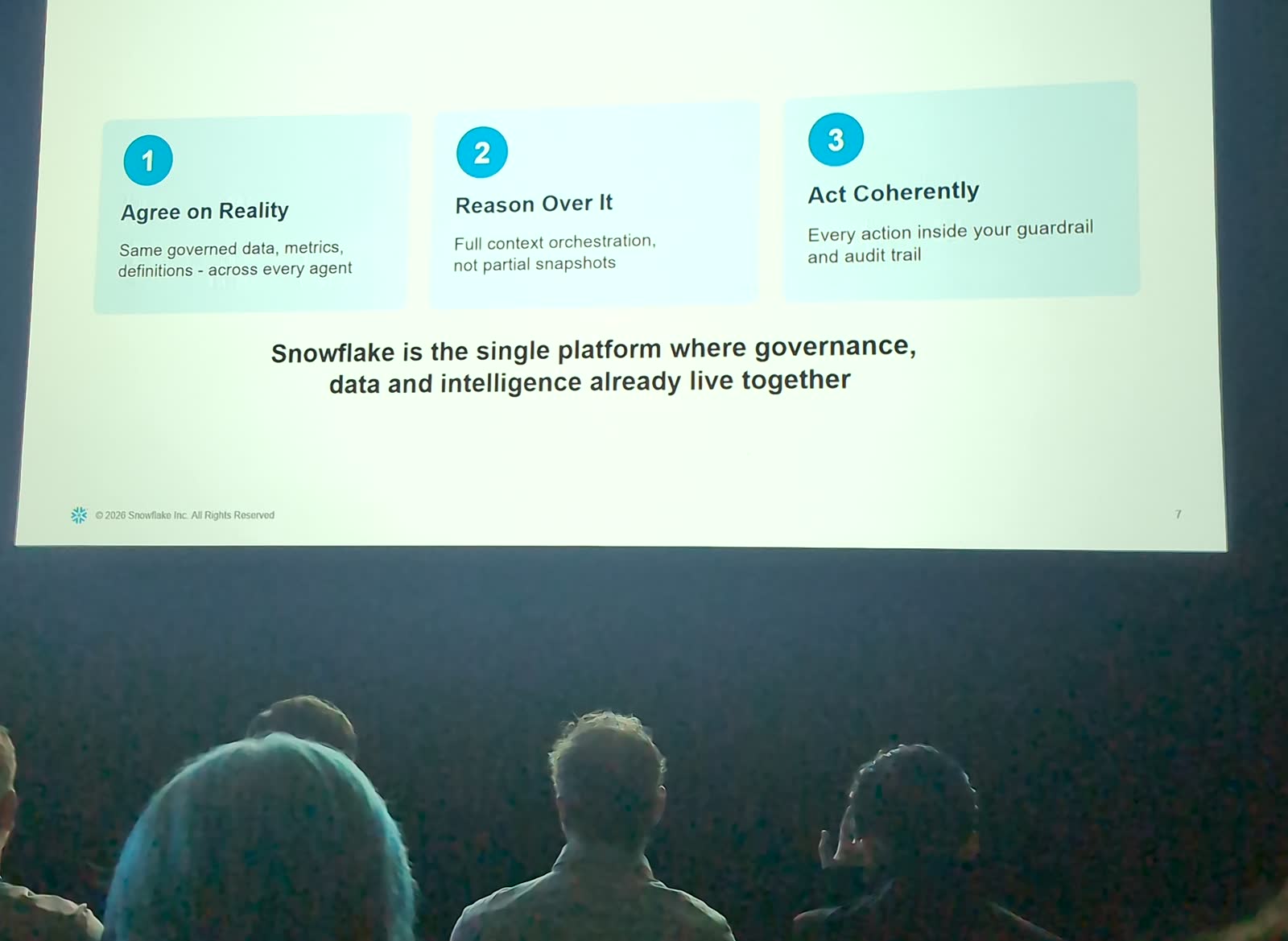
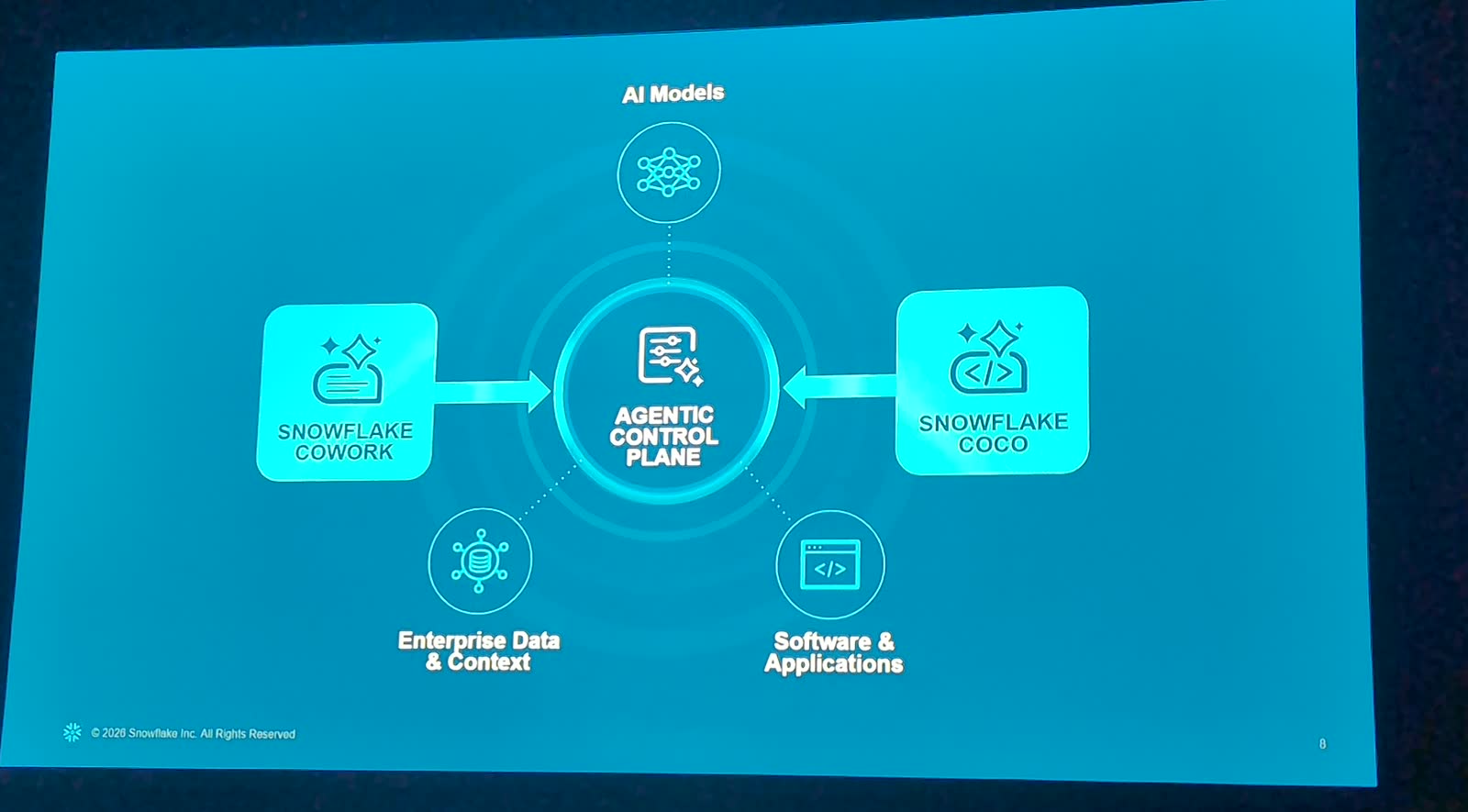
WN217B: Snowflake’s own top-level framing was “agree on reality, reason over it, act coherently” — exactly the governed-context-plus-action pattern behind the whole page.WN217B: the agentic control plane slide connects CoWork, CoCo/Cortex Code, AI models, enterprise data/context, and applications. This is the end-to-end work-platform ambition, not just analytics chat.
Strategic read
The biggest takeaway from the conference: Snowflake may now cover much of the platform layer many teams expected to build themselves.
Agentic data products
Agentic search may be a Snowflake-native composition problem.
The target experience is still right: a user asks a natural-language question; behind the scenes, different agents use tools, searches, semantic definitions, and queries; the answer comes back with a trustworthy trace showing which agents ran, which tables/sources were used, and why the result should be trusted.
Summit changed the implementation question. CoWork/Snowflake Intelligence, Cortex Agents, semantic views, Horizon Context, ontology/knowledge graph patterns, Cortex Search/Analyst, and governed app/action surfaces look close enough that we should test Snowflake as the control plane before building parallel infrastructure.
Secure experimentation
The “all in one Snowflake boundary” part is powerful.
Cortex Code may or may not beat a general-purpose AI assistant. The special advantage is where it runs: inside the Snowflake ecosystem, close to real governed data, without moving production data outside the secure boundary. That makes experimentation with real data and real schemas much easier to justify.
Snowflake Postgres and SPCS extend the same idea from analytics into lightweight apps: build POCs and internal workflow surfaces near the data, then let their app state feed the next analytics/AI loop.
Integration challenge
The hard part is making the new pieces work together.
Semantic views and ontology/knowledge graph both improve answer quality, but they are not automatically one coherent layer. The team needs to work out how semantic definitions, ontology metadata, Horizon Context, Cortex Agents, and traces reinforce each other instead of becoming separate concepts with duplicated meaning.
Semantic views define governed metrics and business-friendly fields.
Ontology/knowledge graph captures relationships, entities, and reasoning paths.
Horizon Context should package that meaning for agents and apps.
The trace layer must show which context and data sources drove each answer.
Enterprise reality
Economics and Microsoft gravity are the brakes.
Snowflake is clearly trying to become the platform where everything happens. That is compelling if the economics work. But EY is heavily Microsoft-oriented — SQL Server, Azure, Fabric, Power BI, Excel — so “do everything in Snowflake” has to beat or complement the Microsoft path, not just look cleaner in a Summit demo.
The test is practical: cost per useful answer, governance quality, latency, traceability, user experience, and how much duplication is created across Snowflake and Microsoft semantic/app layers.
Download the portable AI context brief.
Download a tool-neutral Markdown brief summarizing the Summit 26 signals for AI applications, governed context, semantic layers, agents, and workflow surfaces. It works as human reading material or background context for Copilot and other AI assistants.
Twelve signals shape the follow-up architecture and client conversation.
Semantic Views + AtScale XMLA
Potential route for Power BI and Excel to consume Snowflake-governed metrics live instead of recreating definitions.
Ontology-on-Snowflake
Meaning as metadata: facts stored once, ontology configured, views generated, agents routed across semantic and graph tools.
AI Function Studio
CI/CD-like workflow for AI functions: evals, candidate variants, cost/quality tradeoffs, approval, deployment.
Horizon Context
Snowflake is making semantic context a managed layer for agents, analysts, and customer/work apps.
Cortex AI Functions
SQL-native multimodal functions over text, docs, images, audio, video, and structured data.
Document intelligence
AI_PARSE_DOCUMENT, AI_EXTRACT, and citations/confidence scores turn documents into governed data assets.
CoWork + Cortex Agents
Snowflake's visible move from analytics chat into governed work orchestration and business-tool actions.
DCM + Dynamic Tables
Declarative SQL pipelines become reviewable/promotable infrastructure for agent-ready data products.
Interactive Tables
Snowflake-native low-latency serving for dashboards, APIs, and agent reads with known hot query shapes.
pg_lake
Postgres can participate in object-storage/Iceberg data flows; useful bridge for operational systems and Snowflake AI.
Sigma planning apps
FP&A use cases show BI tools becoming business-user-built workflow and writeback applications on Snowflake.
AI cost governance
Token estimation, budgets, quotas, telemetry, and chargeback are becoming first-class production controls.
June 3 additions
Today sharpened two pieces of the architecture: AI function lifecycle and semantic context lifecycle.
Function lifecycle
Cortex AI Functions are becoming governed agent tools.
The session positioned Cortex AI Functions as SQL-native tools across text, documents, images, audio, video, and structured data. AI Function Studio then adds the lifecycle: describe the task, generate the function, evaluate it, optimize model/prompt/workflow choices, and manage quality/cost before production use.
Custom AI functions, AI_COMPLETE, AI_CLASSIFY, AI_EXTRACT, AI_PARSE_DOCUMENT, AI_TRANSCRIBE, and more.
Evaluation against ground truth, generated labels, or synthetic data using rule-based and LLM-as-judge metrics.
Optimization compares models/configurations against task-specific data instead of generic benchmarks.
Context lifecycle
Horizon Context makes semantics the agent substrate.
The Horizon Context / Semantic Views material framed context as what a business user, app, agent, or executive needs in order to act. The important product direction is semantic context at scale: creating, validating, and reusing shared business meaning across teams and tools.
Horizon Context appears to assemble enterprise context for Snowflake Intelligence and agentic workflows.
Semantic View Autopilot suggests assisted generation/enrichment of semantic views.
The unresolved governance question is who certifies generated meaning and resolves conflicting definitions.
June 4 sharpened the operating model
The last day turned the architecture from “governed AI analytics” into “governed apps and work execution near Snowflake data.”
Citizen apps
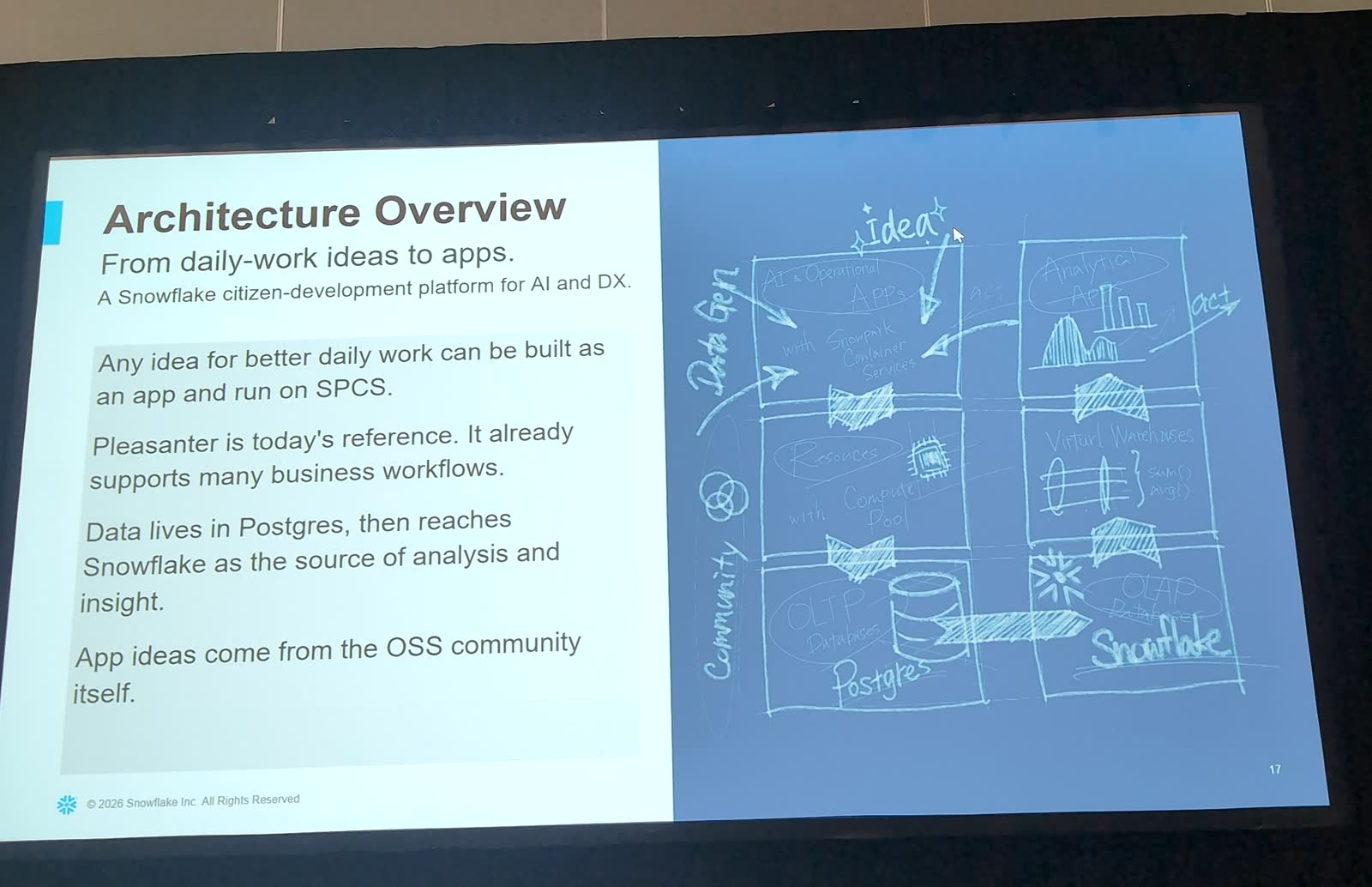
AD212: build the app where the data already lives.
Snowflake Postgres plus SPCS is a credible lane for small internal workflow apps: operational state in Postgres, containers running next to Snowflake, Snowflake identity, Cortex AI Functions behind the scenes, and future MCP-style agent actions through the app rather than direct database mutation.
The Pleasanter reference app showed meeting notes becoming tickets and customer history being prefilled from prior Snowflake rows.
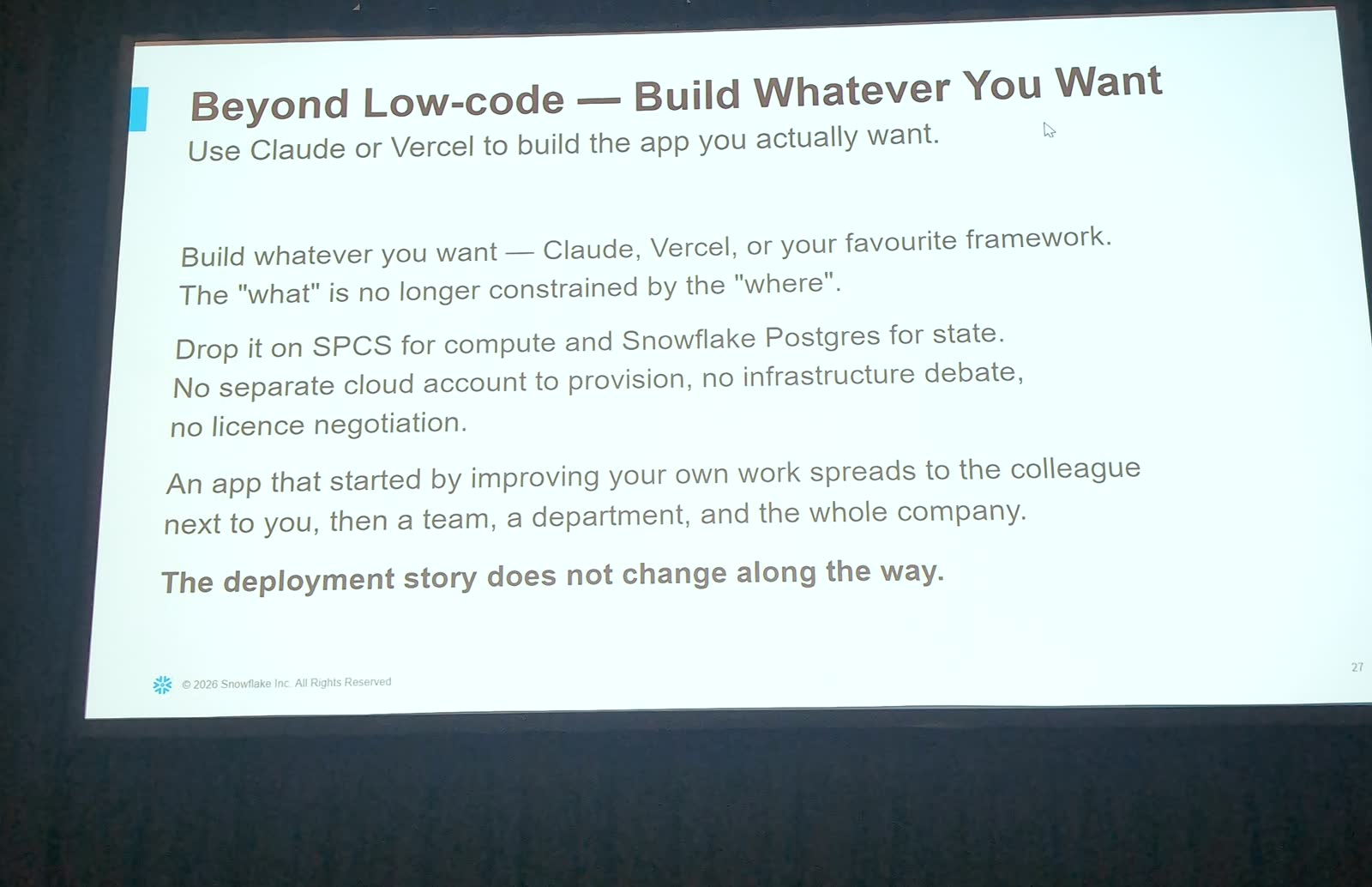
The strongest takeaway is not low-code specifically; it is bring-your-own app/framework near governed data.
WN217B: Snowflake Intelligence is trying to become the governed work-agent layer.
The United Rentals segment was the best practical proof point: a BI Agent on top of trusted Tableau/reporting foundations, semantic views, governed metrics, row-level security, and operational hierarchy — giving branch and sales users explanations and recommended next actions, not just a number.
Snowflake’s three-step frame: agree on reality, reason over it, act coherently.
The right question remains cost: measure cost per useful answer, not just demo quality.
Detailed takeaways
Product notes, strategic interpretation, caveats, and follow-up questions.
Semantic layer
Snowflake wants the semantic layer to become the control plane.
The most important through-line was not any one demo. It was that Snowflake is trying to make business meaning durable and reusable across dashboards, spreadsheets, analytics chat, AI agents, and workflow automations. That matters because most enterprise AI failures are not model failures. They are context failures: conflicting definitions of revenue, inconsistent customer/entity relationships, security rules that do not propagate, and metrics that drift between tools.
If every tool has its own meaning layer, every AI answer is a governance incident waiting to happen.
What looks promisingSnowflake Semantic Views could become a central definition layer for metrics and business entities, with Power BI, Excel, Cortex Analyst, CoWork, and agents consuming the same governed meaning.
What to verifyWhether downstream tools really honor identity, row policies, masking, semantic definitions, and calculation behavior — or whether each integration quietly rebuilds a parallel model.
AtScale + Power BI / Excel
The specific announcement worth knowing is the Snowflake Semantic Views XMLA Endpoint, powered by AtScale. The idea is that Power BI and Excel can connect live to Snowflake Semantic Views through familiar XMLA / Analysis Services style patterns. Power BI gets live access without recreating the model in Power BI first; Excel gets PivotTables, slicers, and CUBE-function style usage over governed Snowflake definitions.
Strategically, this is strong if Snowflake is the semantic source of truth and Microsoft tools are consumption surfaces. It is weaker if the enterprise expects Power BI semantic models to remain canonical. The critical question is whether AtScale is exposing the Snowflake model directly or creating a second semantic system that must be synchronized and governed separately.
For agentic data-product teams, semantic views should probably be treated as the metric and business-field contract: the layer that keeps natural-language questions from turning into ad hoc SQL interpretation. The open design issue is how that contract interacts with ontology metadata and knowledge-graph reasoning without creating two competing meaning systems.
Ontology
Ontology-on-Snowflake is “meaning as configuration.”
The ontology demos were especially relevant because they showed an explicit stack for relationship-aware AI. The core pattern was: store generic graph facts once, define ontology metadata separately, generate views from the ontology, expose semantic models, then let Cortex Agents route across graph analytics, concrete facts, abstract ontology concepts, and governance metadata.
Layer 1Physical storage such as KG_NODE and KG_EDGE.
Layer 2Ontology metadata: classes, relationships, rules, and meaning as configuration.
Layer 3Generated ontology views such as VW_ONT_PERSON.
Layer 5Cortex Agent plus graph analytics and routing tools.
Why it mattersIt turns relationship knowledge into inspectable Snowflake objects instead of hidden prompt glue.
The related ontology-stack-builder Cortex Code skill appears to build this in phases: gather inputs, recommend an ontology, visualize and confirm, create the physical and view layers, ensure the base semantic layer, create ontology semantic views, create the Cortex Agent, and validate. The workflow is interesting because it has approval gates. It is not just “let the model make a schema.”
For tax technology, this maps cleanly to entity/investor/partnership relationship problems. You can imagine facts stored once, meaning configured in ontology metadata, and agents answering questions by traversing governed relationships rather than improvising over flattened tables.
The useful next design question is not “semantic views or ontology?” It is which questions require governed metric definitions, which require relationship reasoning, and how an answer trace can show both: the semantic view that defined the measure and the ontology/graph path that connected the entities.
AI lifecycle
AI Function Studio looked like CI/CD for AI behavior.
This was one of the coolest things I saw because it addresses a real enterprise problem: how do we improve AI functions without turning production into a prompt experiment? The demo pattern showed candidate variants, evaluation metrics, score/cost/throughput tradeoffs, and an approval step before applying an optimized function.
Public material indicates AI Function Studio is in Public Preview and can create, evaluate, optimize, and publish Cortex AI Functions. The optimization pattern appears to be Genetic-Pareto / Pareto-frontier style: generate candidate functions, evaluate them, compare quality and cost, preserve function signatures, and choose whether to promote the improved version.
Why this mattersIt treats AI behavior as a promotable production object with evals and approval gates, not as a one-off prompt pasted into production.
Still unknownWhether rollback, approval logs, candidate diffs, eval storage, and promotion history are first-class enough for serious regulated workflows.
Tax / BI use cases
Legal-term extraction from partnership agreements.
K-1 exception classification and reviewer triage.
Document-to-common-data-model mapping.
Reconciliation explanation generation.
Quality/cost optimization for high-volume document processing.
The important caveat: it appears GEPA-like in spirit, similar to DSPy GEPA, but Snowflake has not confirmed that it literally uses DSPy.
Cortex AI Functions
AI functions are the production primitive under the agent story.
The June 3 session made the function layer much clearer. Cortex AI Functions are positioned as SQL-native AI over every major enterprise data type: text, documents, images, audio, video, and structured data. The visible function portfolio included custom AI functions, AI_COMPLETE, AI_CLASSIFY, AI_FILTER, AI_AGG, AI_EMBED, AI_EXTRACT, AI_SENTIMENT, AI_TRANSLATE, AI_TRANSCRIBE, and AI_PARSE_DOCUMENT.
Why it mattersAgents need callable tools with known behavior. AI Functions are Snowflake’s way to make extraction, classification, summarization, transcription, sentiment, and document reasoning callable inside governed SQL workflows.
What to verifyWhether functions, prompts, eval data, candidate results, human approvals, and deployed versions are durable objects with diff, promotion, and rollback semantics.
Document intelligence is the immediate enterprise wedge
The document slides showed AI_PARSE_DOCUMENT, AI_EXTRACT, and AI_COMPLETE turning document libraries in S3/GCS/Azure/Snowflake into structured extraction, enterprise search, research analytics, and agent interfaces. The key phrase: documents become governed data assets.
AI_EXTRACTSchema-based extraction with citations, confidence scores, bounding boxes, and human review for low-confidence rows.
AI_CLASSIFYOne SQL call for text, images, and documents; single-label or multi-label; up to 100 categories per call and 100 pages per document.
AI_COMPLETENow includes video and audio alongside text, documents, and images for media workloads such as call scoring and creative tagging.
Semantic context
Horizon Context is the other half of the agent-control story.
If AI Function Studio governs behavior, Horizon Context is aimed at governing meaning. The slides framed semantic context as the shared layer that lets business users, customer apps, executives, and agents get consistent answers from the same enterprise understanding.
The most interesting product signal was Semantic View Autopilot. The photos suggest a workflow that starts from existing data, SQL, or usage context; recommends or generates semantic views; then routes them toward review, enrichment, and governed consumption. That is exactly where enterprises need help — not because writing YAML or SQL is hard, but because certifying meaning across teams is political and operationally messy.
The hard problem is not generating a metric. The hard problem is making sure every analyst, dashboard, app, and agent means the same thing when they use it.
Strong signalSnowflake is explicitly connecting Horizon Context, Semantic Views, Snowflake Intelligence, and agent consumption. Semantic meaning is moving closer to the platform center.
Open riskAutogenerated semantic views are useful only if validation, certification, ownership, and conflict resolution are first-class. Otherwise they just automate semantic drift.
Why BI233 cares
PE tax work has the same context problem: funds, LPs, entities, documents, obligations, jurisdictions, quality rules, exceptions, and reviewer logic need shared meaning before agents can safely help. Horizon Context and Semantic Views are the Snowflake-native vocabulary for that argument.
Production controls
Cost governance is becoming part of AI architecture.
The AI Function session included a useful cost-governance frame: control cost before, during, and after AI queries. Before the query: token counting and cost estimation. During the query: incremental metering, low-latency budgets, and user quotas. After the query: account usage telemetry, per-role/per-tag attribution, and chargeback reporting.
This matters because agents can multiply AI calls. A single analyst asking a question is manageable; background automations calling multimodal functions across thousands of records can create surprise spend quickly. Production AI needs budgets, quotas, attribution, and auditability in the same way production data workloads need warehouses, monitors, and ownership.
This is one of the biggest adoption gates for agentic data-product teams. The demo path may work beautifully, but if every natural-language question fans out into multiple Cortex Agent steps, semantic queries, Cortex Search calls, AI function invocations, and app/tool actions, the team needs a cost model before broad rollout. Measure cost per useful answer and cost per completed workflow, not just credits consumed by isolated features.
Data pipelines
Dynamic Tables plus DCM Projects are the pipeline substrate for agents.
The sign that said “Autonomous SQL Pipelines for AI Agents” was pointing at a practical issue: agents are only useful if the data they inspect is fresh, shaped, governed, and explainable. Dynamic Tables handle runtime refresh and dependency tracking. DCM Projects — Database Change Management Projects — are the lifecycle wrapper for database objects.
Dynamic TablesMaterialized SQL transformations with target lag, automatic refresh, and dependency tracking.
DCM ProjectsDeclarative change management for objects such as Dynamic Tables, tasks, views, roles, grants, schemas, and warehouses.
The agent angle is simple but important: an agent should not rely on hand-built, invisible ETL spaghetti. It should rely on data products whose definitions can be reviewed, tested, reviewed, promoted, and monitored. DCM Projects are Snowflake’s move toward making those definitions lifecycle-managed.
Apps near data
Snowflake Postgres + SPCS is the citizen-development part of the story.
AD212 made the practical app lane clearer: Snowflake Postgres stores operational state, SPCS runs the app/container/MCP server, Snowflake identity controls access, and zero-ETL/mirroring/pg_lake-style paths make app data analyzable without a custom pipeline. The provocative line was simple: build the app where the data already lives.
AD212: the reference architecture put daily-work apps on SPCS, app state in Snowflake Postgres, and analytics/AI back on Snowflake — the useful app-runtime pattern.AD212: the important point was broader than Pleasanter: Claude, Vercel, or a normal framework can build the app; Snowflake supplies the governed place to run it and store state.
Why it mattersMany tax and operations workflows are not dashboards. They are queues, comments, approvals, exception records, relationship edits, and review decisions. Those belong in apps, and the app data should feed the analytical/AI loop.
What to verifyNative SPCS-to-Postgres networking, Snowflake Postgres maturity/availability, Native App upgrade path, role mapping, MCP action audit, and whether the cost model still works for always-on workloads.
Example workflow pattern
A K-1 / fund-tax exception workbench: Postgres stores items, comments, assignees, status, and decisions; SPCS hosts the UI; Snowflake tables provide fund/entity/investor context; Cortex drafts summaries; MCP tools can propose updates while humans approve final state changes.
Another practical lane: use Snowflake-native apps for POCs that need real data but should not move that data out of the Snowflake boundary. Start with narrow internal workflows, not broad platforms: fund-to-corporate handoff, exception review, data-quality triage, semantic-view QA, or agent trace review.
Open source / Postgres
pg_lake makes Postgres a lakehouse participant.
pg_lake is an open-source Snowflake/Crunchy Data lineage project that lets Postgres query and manage object-storage data with familiar SQL. It supports formats such as Parquet, CSV, JSON, and Iceberg-oriented tables; import/export through Postgres COPY; and patterns where Postgres can create/manage Iceberg tables that Snowflake can later read through catalog integration.
This is not Debezium-style row-level CDC. It is object-storage / file / Iceberg oriented. The strategic reason it matters is that many operational systems still live in Postgres, while analytics and AI workflows increasingly want open table formats and object storage. pg_lake helps bridge that world without making every Postgres workload pretend to be a full warehouse.
Useful mental modelPostgres can remain operationally familiar while participating in lakehouse-style data movement and sharing with Snowflake.
Serving layer
Interactive Tables are Snowflake’s low-latency serving story.
Interactive Tables and Interactive Warehouses are Snowflake’s attempt to serve low-latency, high-concurrency workloads without pushing teams into a separate serving database. This is relevant for live dashboards, embedded analytics, APIs, observability, and agent workloads that need fast structured-data access.
The mechanics matter: Interactive Tables require clustering, can be created via CTAS or auto-refresh with target lag, and are served by Interactive Warehouses. Standard warehouses still create/load/refresh; Interactive Warehouses serve fast concurrent SELECTs. Recent updates include auto-suspend/resume, Search Optimization support, manual scaling, storage lifecycle policies, and fallback warehouses for queries that exceed interactive-timeout expectations.
Important limitationThis is best for known hot query shapes. It is not a universal replacement for exploratory analytics.
Agents / work
Snowflake Intelligence / CoWork is the move from analytics chat to work execution.
Snowflake Intelligence / CoWork is the business-user work surface in this story. The positioning is broader than asking questions over data: personal work agent, business-tool integrations, automations, artifacts, skills, and actions. The architecture mental model is: CoWork is the user-facing surface; Cortex Agents plan and orchestrate; Cortex Analyst handles structured data through Semantic Views; Cortex Search handles unstructured retrieval; Cortex Sense supplies context; MCP/Natoma connects tools; Agent Studio manages lifecycle and governance.
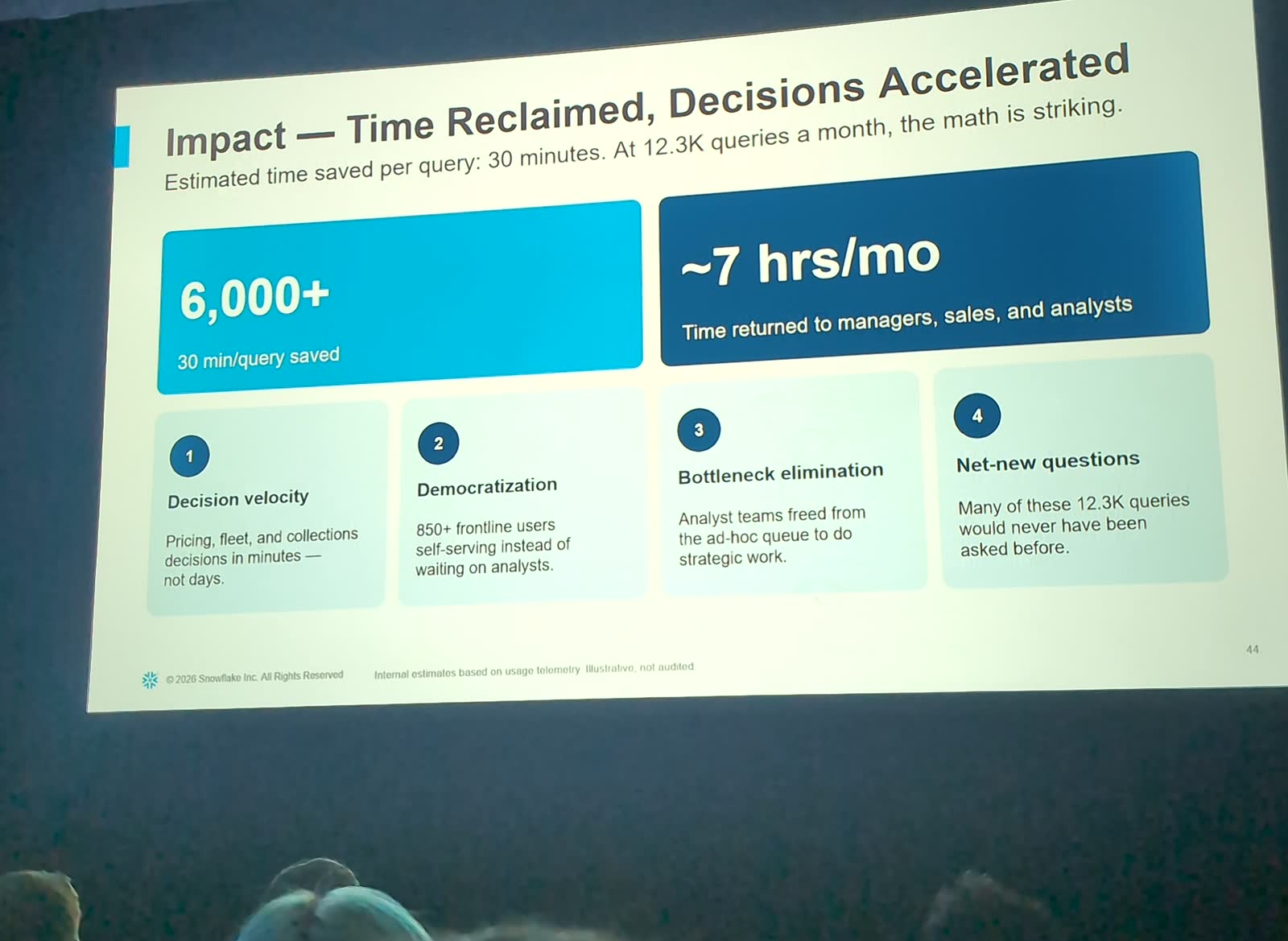
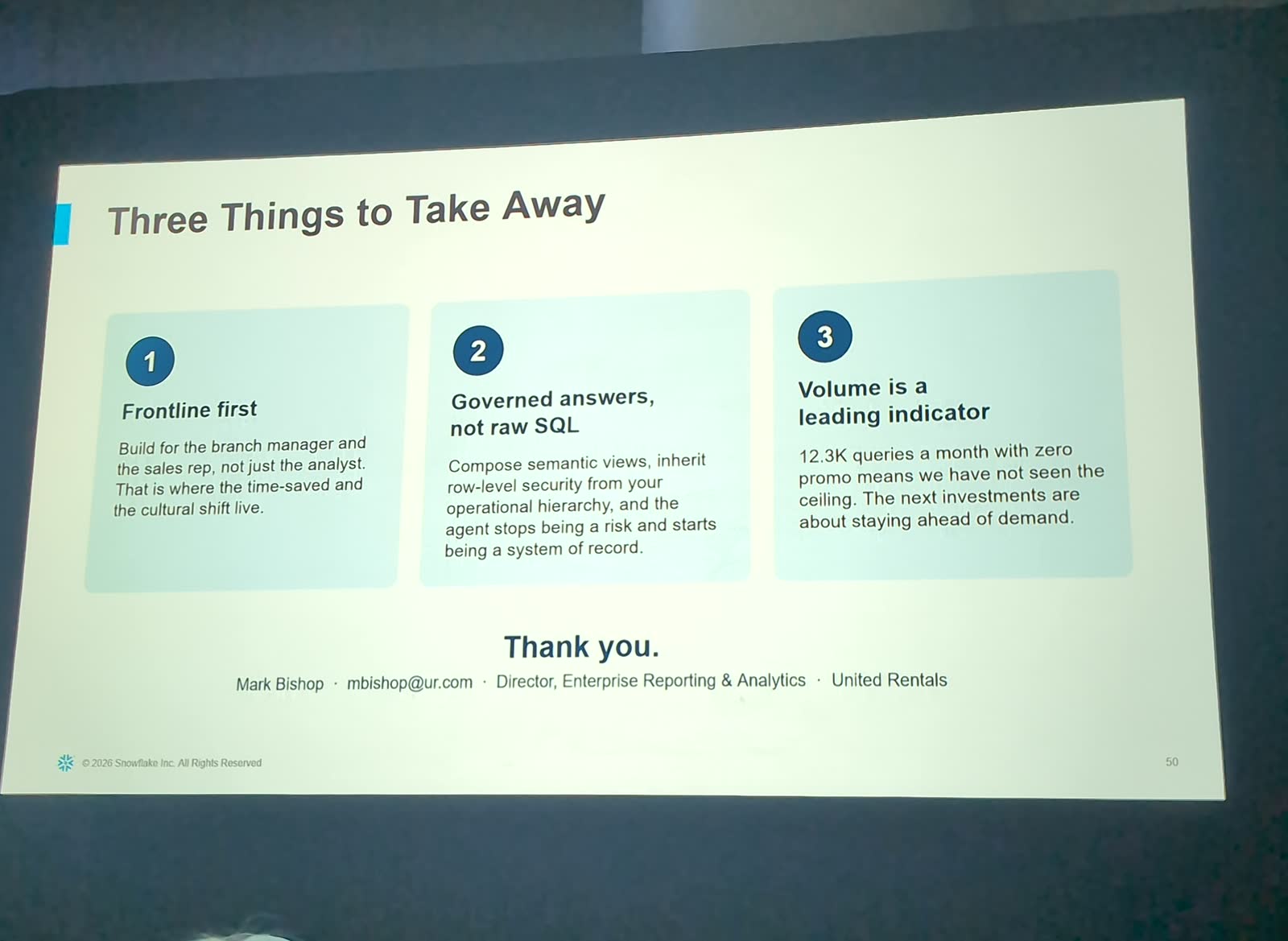
United Rentals proof point: Snowflake Intelligence was framed as time reclaimed and decisions accelerated — 12.3K queries/month, 850+ frontline users, and 6,000+ hours/month claimed on the slide.Why it matters: their takeaways were frontline first, governed answers not raw SQL, and volume as a leading indicator. That is much more concrete than a generic “chat with data” demo.
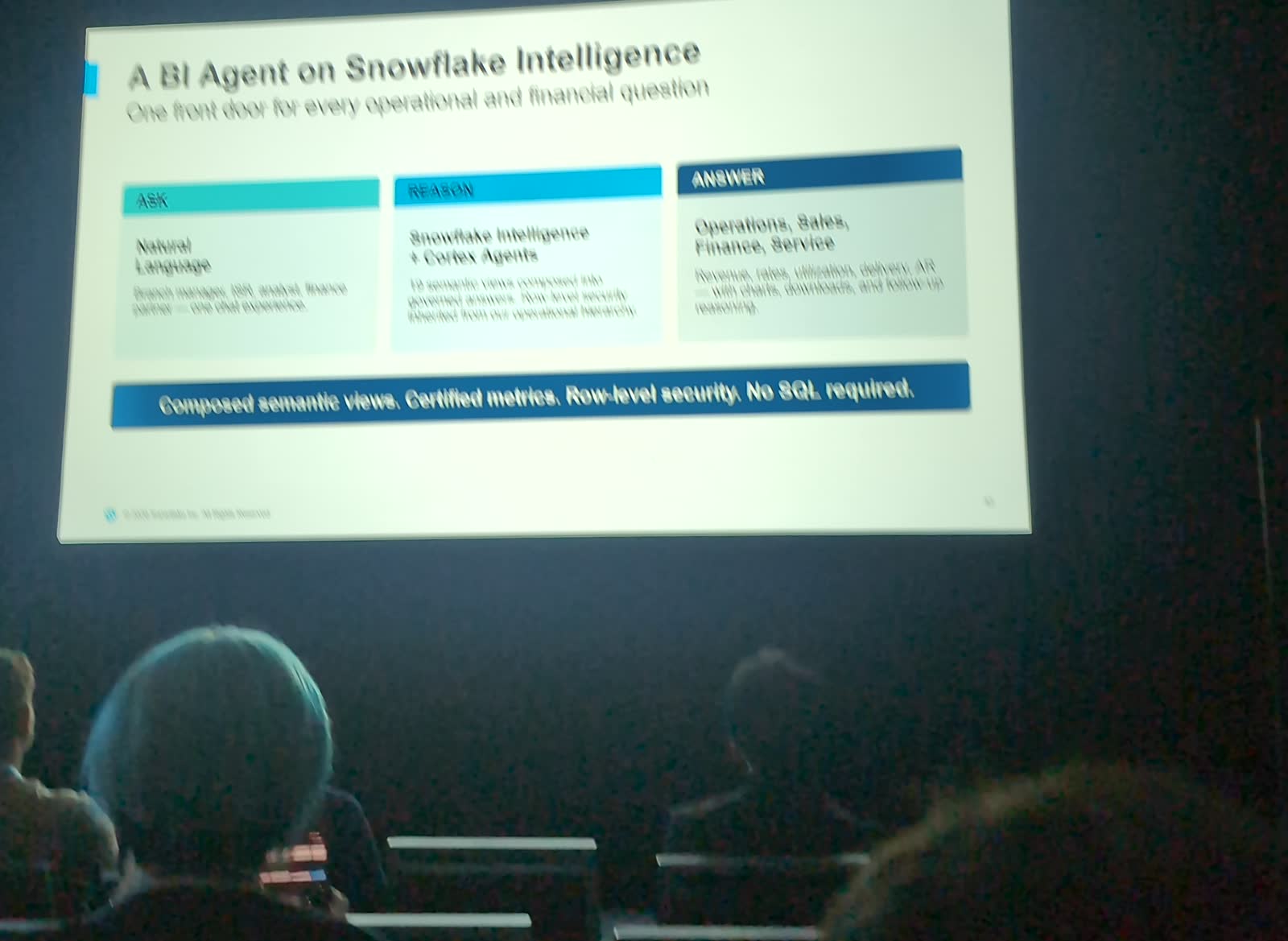
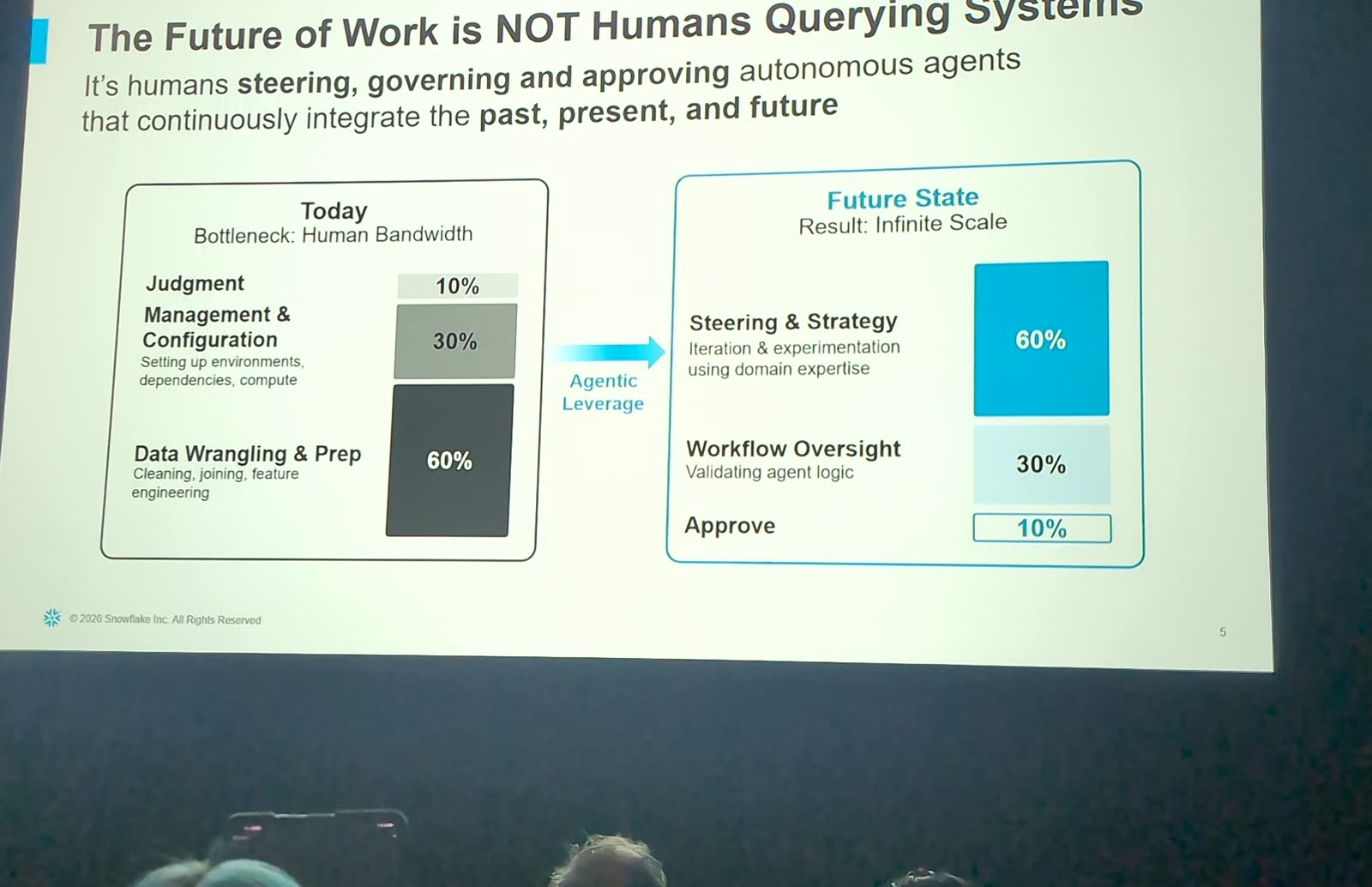
How the BI agent is positioned: ask in natural language, reason through Snowflake Intelligence + Cortex Agents, answer from governed operations/sales/finance/service data — with semantic views, metrics, row-level security, and no SQL required.Strategic frame: Snowflake pitched the future as humans steering, governing, and approving autonomous agents — not merely humans querying systems faster.
The hard part is not the chat UI. The hard part is action governance. Can CoWork safely read governed metrics, investigate root cause, draft an action, ask for approval, execute through Slack/Salesforce/Jira/etc., and leave a usable audit trail? If yes, Snowflake starts looking like a governed work execution platform. If no, it is another polished analytics assistant.
For our agentic-search pattern, the trace is not a nice-to-have. The answer needs to show what agents/tools ran, which tables or documents were touched, which semantic definitions were applied, and where confidence/citations came from. That is what turns “the AI said so” into something a reviewer or client team can trust.
The demo to ask for: show an automation that reads governed metrics, investigates root cause, drafts an action, and shows every approval and audit point.
BI / planning
Sigma FP&A use cases suggest BI is becoming app-building.
The Blackstone/Sigma FP&A signal was interesting because budgeting and forecasting are not just dashboards. They require writeback, versions, scenarios, approvals, workflow, and business-owned logic. If finance teams are building budgeting/forecasting apps in Sigma on Snowflake, Sigma is functioning as a business-user application layer — not merely a BI surface.
That is powerful if governed well. It is dangerous if every analyst-built workbook becomes a shadow finance application with unclear formula ownership, weak promotion process, and murky writeback controls. The question is not “can Sigma do planning?” The question is how a workbook becomes certified production infrastructure.
The fund-to-corporate handoff is a concrete place to test the Snowflake/Microsoft boundary. A Snowflake semantic view could feed Excel and Power BI through XMLA while also feeding a Snowflake-native visualization or app. If Snowflake’s own visualization/app layer is good enough, keeping data, semantics, and AI context together may be cleaner. If Power BI remains the better user surface, Snowflake can still be the governed semantic source instead of trying to replace every front end.
Why this matters to us
BI233 aged well — and agentic data-product teams may get smaller.
The PE tax relationship-data framing lines up very well with the Summit direction. So do the agentic data-product teams ideas around agentic search and trusted answer traces. The best version of enterprise AI here is not generic copilot usage. It is governed business context plus narrow agents tied to real operating workflows, with Snowflake potentially providing more of the substrate than expected.
Relationship dataEntity, investor, fund, partnership, document, obligation, and transaction relationships matter more than isolated rows.
Common meaningAI needs shared business definitions and governance, not six competing semantic layers.
Narrow agentsThe credible path is specific workflows: extract, classify, reconcile, explain, approve, and route.
A useful client-facing angle: “Generic copilots are not enough. Useful enterprise AI needs governed business context and narrow workflow agents with lifecycle controls.”
Questions this raises for us
Pressure-test questions before treating the demos as production-ready enterprise patterns.
AtScale / XMLAIs the endpoint generated directly from Snowflake Semantic Views, or does AtScale maintain a parallel model? What Power BI features are limited?
Security passthroughDo Snowflake identity, RBAC, row access policies, masking policies, and tags survive through Excel, Power BI, Cortex, and CoWork?
AI Function StudioWhere do eval sets, candidate bodies, diffs, approvals, version history, and rollback live? Can it optimize agent instructions or only standalone functions?
Horizon ContextWhat exactly is stored as durable context, who certifies Semantic View Autopilot output, and how are conflicting metric definitions resolved?
AI cost controlsHow do budgets, quotas, token estimation, and chargeback behave when agents call AI Functions recursively or at bulk scale?
CoWork automationShow a workflow that reads governed metrics, investigates root cause, drafts an action, and identifies approval and audit points.
DCM / Dynamic TablesHow do PREVIEW, TEST, REFRESH, environments, grants, and Dynamic Table target lag fit into CI/CD for data products?
Sigma / planning appsWhere does writeback land, who owns formulas, and how does an analyst workbook become certified production finance infrastructure?
Agentic data productsWhich platform pieces should we stop building ourselves because Snowflake now provides them, and which domain-specific layers still need custom product work?
TraceabilityCan every answer expose agents/tools used, semantic views applied, tables/documents touched, confidence/citations, and human approval points?
Semantic + ontology fitHow do semantic views and ontology/knowledge graph work together without creating duplicate meaning layers?
Microsoft boundaryWhere should Snowflake be the system of record/control plane while Excel, Power BI, Fabric, or Azure remain the right user or enterprise surface?
Team summary
The condensed version.
What changedSnowflake is assembling a governed AI work platform: semantic context, ontology/graph patterns, pipelines, low-latency serving, multimodal AI functions, function optimization, agents, Snowflake-native apps, cost controls, and familiar BI/spreadsheet surfaces.
Why we careEnterprise AI fails when meaning, access, function quality, spend, evals, traceability, and actions are unmanaged. Summit 26 suggests Snowflake wants those controls inside the data platform, which could materially change build-vs-compose decisions for agentic data products.
Best client angleDo not sell “chat with data.” Sell governed business context plus narrow workflow agents for real operating tasks — with answer traces that show how the system reached the result.
Still unprovenAI Function Studio rollback/versioning, Horizon Context object model, Semantic View Autopilot certification, ontology/semantic-view integration, trace/audit depth, cost per useful answer, AtScale feature limits/security passthrough, CoWork action governance, Sigma production controls, and Microsoft/Fabric boundary decisions.
Immediate next stepUse the AI context brief as portable background for discussion, summarization, product planning, or repository-aware analysis.